What is a competency framework and why you should care about having one?

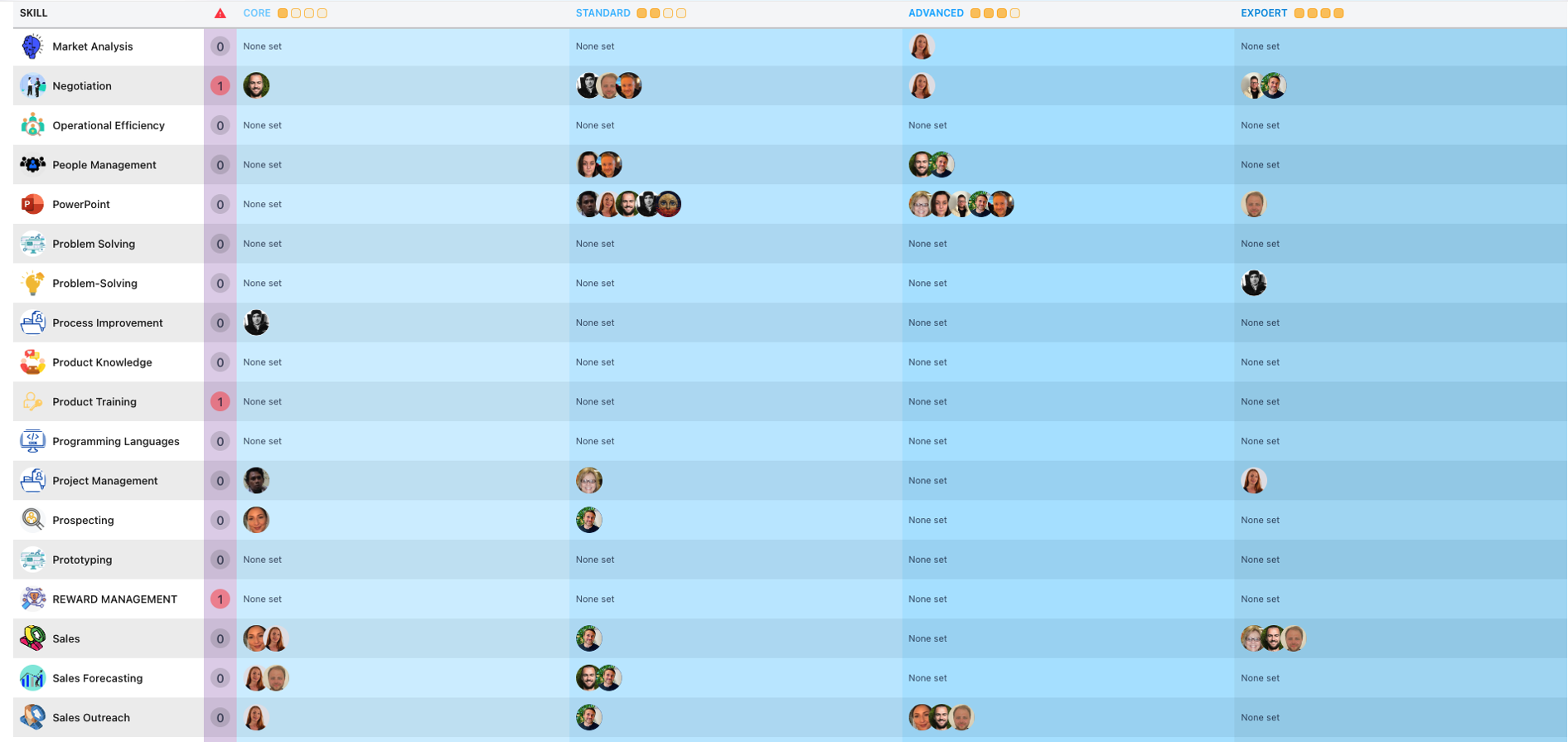
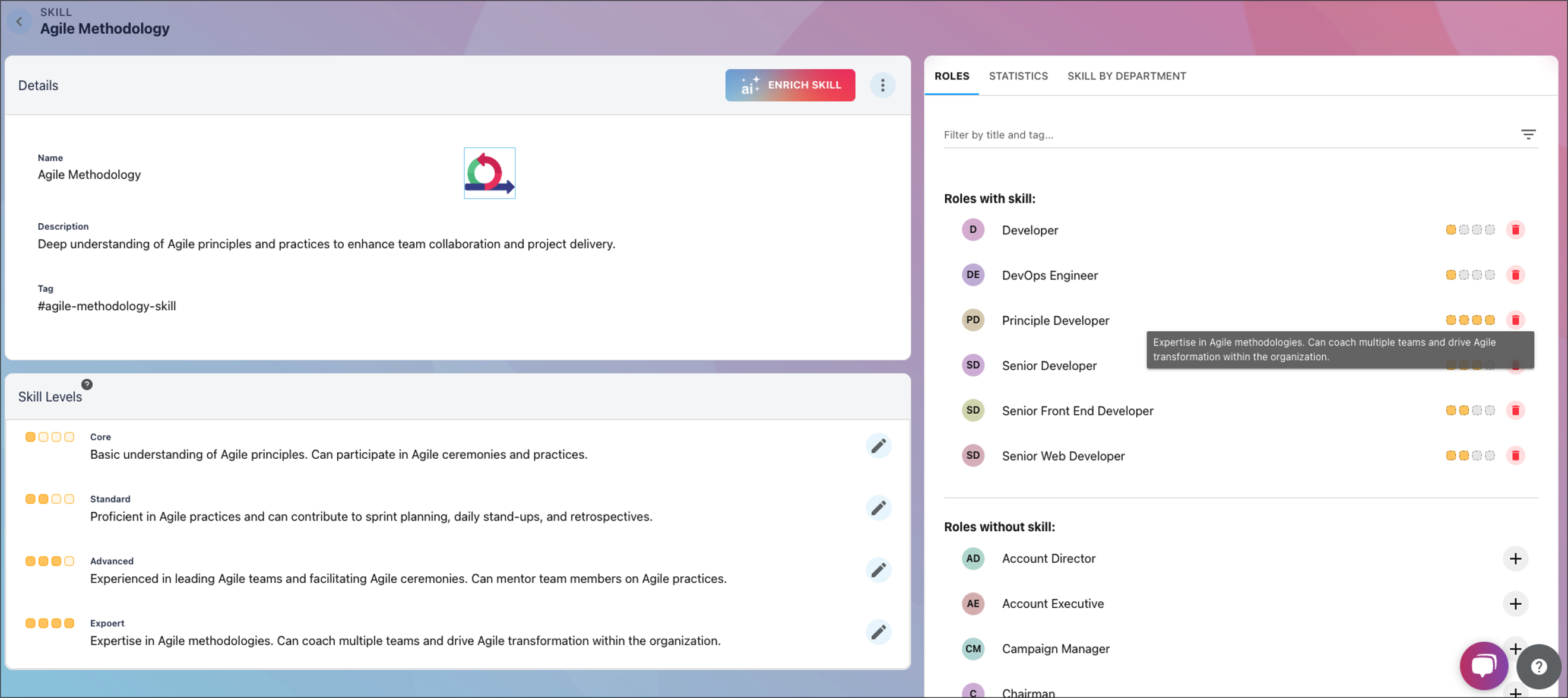
A competency framework is a set of roles, succession roles, skills, skill levels and behaviours that are essential for each role in an organization. It defines a statement for each skill level so its easier to accurately measure how to measure and observe them in action.

It can also be extended to show career pathways, the paths which can be taken from one role to another more senior role. By understanding what these skills gaps are we can more easily close these gaps by taking training and by executing in the day to day.

What advantages does it bring if you have a competency framework?

Having this underlying framework creates a data-based foundation for you to build your individual employee career development plans and succession planning.

In practical terms it enables you to visualise skill gaps across the organisation and see single person dependencies – for example where you have only one person with that particular level of skill so you can train others to remove risk or losing that capability altogether.

Overall having a competency framework enables you to employ a data driven approach to employee development and succession planning and this improves transparency, consistency, reduces bias and increases visibility for every member of the organization.  It also helps you connect career pathways to learning pathways more easily and can provide a more accurate hiring process, reducing mis-hires.

So why haven’t more organizations got this?

The simple answer is that it is very complex and time consuming to create and maintain a competency framework. As beneficial as it is, running a competency framework has largely the realm of large enterprise and beyond the resources and capabilities of many small to medium sized organizations. There are existing frameworks available, but these are either overly complex or too vanilla to be deployed effectively.  

Even for organisations that have got one, the average time to create a competency framework for a 300-employee organization is 6-9 months and requires at least one full time person, using an L&D manager to maintain it. This puts of many people from implementing one.

That is, until now.

Recent advances in technology aided by AI, particularly by a UK tech company called StaffCircle® has brought this capability into the reach of small and medium sized organizations. Hyper personalized competency frameworks – individualised for each organisation can now be created in a matter of minutes.

What used to take 6-9 months to create now takes as little as 20 minutes.

Welcome to the future of AI Assistant Employee Development.

Predictions for HR Technology in 2020

HR Technology Predictions for 2020

The HR Technology sector has continued to expand in 2019 with many new innovative solutions covering many aspects of  the employee lifecycle including recruiting, managing performance, optimising experiences, on-boarding and off-boarding. for employees.

At a time of maximum employment for the Western Economies, Businesses desire to create better environments and experiences for  their employees which has fuelled the growing market in employee engagement and performance tools. Organisations care about their brand more than ever, not just for customers but for employees. Millennials and Gen Z care deeply about their future employers Values,  Mission,  Corporate and Social Responsibilities. Organisations are scrambling to deliver better visibility into the Corporate Soul.

The HR Technology sector has continued to expand in 2019 with many new innovative solutions covering many aspects of  the employee lifecycle including recruiting, managing performance, optimising experiences, on-boarding and off-boarding. for employees.

At a time of maximum employment for the Western Economies, Businesses desire to create better environments and experiences for  their employees which has fuelled the growing market in employee engagement and performance tools. Organisations care about their brand more than ever, not just for customers but for employees. Millennials and Gen Z care deeply about their future employers Values,  Mission,  Corporate and Social Responsibilities. Organisations are scrambling to deliver better visibility into the Corporate Soul.

Prediction #1 – Move to greater home-working  Climate change, Me Too and Organisations wanting to attract and retain the very best people, need to have more flexibility on working patterns. Now with the availability of video and IM technology people can reduce the amount of time travelling to work. We will see a more mixed mode of work – some in the office some at home. Home working will require companies to have  better systems to manage performance, culture and feedback.

Prediction #2 – Greater visibility into the Corporate Soul (corporate brand 2.0)   Climate change, Me Too, Social Care and Responsibility….these are the things that Millennial and Gen Z care deeply about.  Organisations wanting to attract and retain the very best people, need to have a highly visible Corporate Soul which reflects the desires and aspirations of their employees

Prediction #3 – Market Consolidation – 2020 will see the start of consolidation of various HR “point” solutions in the market place driven by the need of companies to combine various technologies into a single solution.

Prediction #4 – Mobile first solutions will increase – The reach of these advanced technologies will extend to mobile, not just for simple items like booking holidays but advanced processes like managing performance appraisals and KPIs. The driver for this will be larger businesses with a split of office and non-desk / front line workers desire to have one system for everyone.

Prediction #5 – Machine learning will further extend into the HR space and move up from performing simple repetitive tasks to more complex items like interfacing handwriting recognition and sentiment analytics which will provide businesses with predictive churn alerts and also provide “leadership discovery” – highlighting future managers and leaders based on many data points.

Prediction #6 – Rise of the Employee Relationship Platform – companies wanting to provide better employee experiences at scale will turn from single point software to all encompassing Relationship platforms. These new types of platforms will grow out of the desire to provide full cycle employee relationship management and flexibility.

Prediction #7 – Company Perks become defacto – perks stop becoming a perk once everyone has them as default and the company perks (discount gym and cinema etc etc) become standard.  Company Perks 2.0 are deeper and more meaningful for the employee – items like  Private Healthcare for all employees and new eco travel options will become more common.

Engage, Empower and Enhance your workforce with StaffCircle

Today our company is proud to announce the release of StaffCircle, an Employee Communications and Workforce Automation Platform. A platform literally years in the making! A culmination of my 20 years experience in founding and growing a number of high performance businesses and our team’s 52 years experience in building enterprise software.

During this article, as CEO and Founder of StaffCircle I seek to explain why we created the platform,  what problems it solves and the new capabilities and insights that can now be delivered to employees and businesses leaders worldwide.

It’s no secret that over the last decade there has been a fundamental shift in the way we work, how and where we work and the duration of that tenure. In a period of mass employment, organisations need new insights to effectively manage, engage and enhance their distributed workforce whilst being flexible enough to serve their full-time office and home workers, senior managers, line managers and team leaders, part time employees and full-time or zero-hour contractors. Companies need to retain complete visibility of workers giving them a voice to ensure fairness and propriety and enabling employees to access the information required to excel at their work.

A parallel exists in sales organisations. 15 years ago, most sales teams around the world managed their business pipeline and general workflow using a mixture of email, word documents, spreadsheets and maybe an access database. These generalist applications were used because there wasn’t any specific application for the purpose of salesforce automation. Then as the sales and service processes became even more complex the spreadsheets no longer cut the mustard. CRM systems came along and changed the way we all managed leads, deal pipeline, customers and associated workflows. Our sales managers now look at graphical web dashboards to show performance trends and forecasts. Cloud based CRMs gave companies flexibility and mobility in the way the application was deployed. Also CRM has helped business enormously because of the extendibility of the platforms via their app stores since you can plug other functionality into CRM system to help with other parts of the processes like marketing systems, web chat, electronic Contracts and so forth.

Now look at people management, especially in non-desk-based environments. It’s a role split across many parts of the organisation; the HR department, the internal communications team, the line managers, team leaders, department leads and the employees themselves. Where is the system that helps co-ordinate these people helping to engage, empower and enhance our employees and their teams?

Mostly its disparate non-linked applications, spreadsheets or basic HR for time management, word/google docs for one2one reviews, PowerPoint (for org charts) a bit of slack or skype for chat, survey monkey for feedback, possibility an LMS (learning system) and maybe an improvements portal for collecting ideas. How many of these systems are connected to give a complete picture of the person or complete automated workflow. How many of these systems can be accessed by 100% of the workforce from any location on any devices ?

The maturing of cloud technology and proliferation of smartphones found in almost every persons pocket hints at a solution.

We believe that people at work need to deliver and receive communication in the most efficient way possible, at any time in any location on any device. It’s not just about communications its about the relevance and value of that communication. Its not just about training, or rewards that drive behaviours its the full picture of work – a timeline of all our activities. Because our productivity output is the culmination of all we do, the tasks we completed, our communication, our achievements, training we completed,  colleagues we helped, suggestions we gave, feedback we received, improvements we made.

For this to happen there needs to be a new type of work platform that sits directly with the employee but links to the ATS , marketing and communications systems, the HR-Payroll Platform and the CRM that joins these systems together to offer better communication and information to employees and meaningful analytics and workflow automation to management.

The Bottom line is that in order for management to get a true picture of an employee you need to see their full engagement not just their last one 2 one review or anecdotal information.

Only when you can see the big picture can you understand the person and make decisions based on real insights using multiple interlinked data points and time periods.

StaffCircle creates a win-win for both the employee and the back-office. It helps solve the problem of workforce management and also gives the worker a direct line to the top of the organisation, helping them become more empowered, improving engagement and productivity of all workers and the businesses they serve. Our mission is to engage, empower and enhance people at work.

Welcome to StaffCircle, please request a demonstration to find out more or run our easy to use Return on Investment Calculator to see how much your business could add to its bottom line by implementing the StaffCircle platform.

Unifying Customer Touch-Points within Recruitment

Business process automation is becoming a common discussion point for larger Recruitment organisations using advanced CRM systems. The ability to “systemize” process creates consistency , predictability and scalability.  The visualisation of performance using user friendly Dashboards and Reports enables management  to scrutinize  and control crucial KPIs.

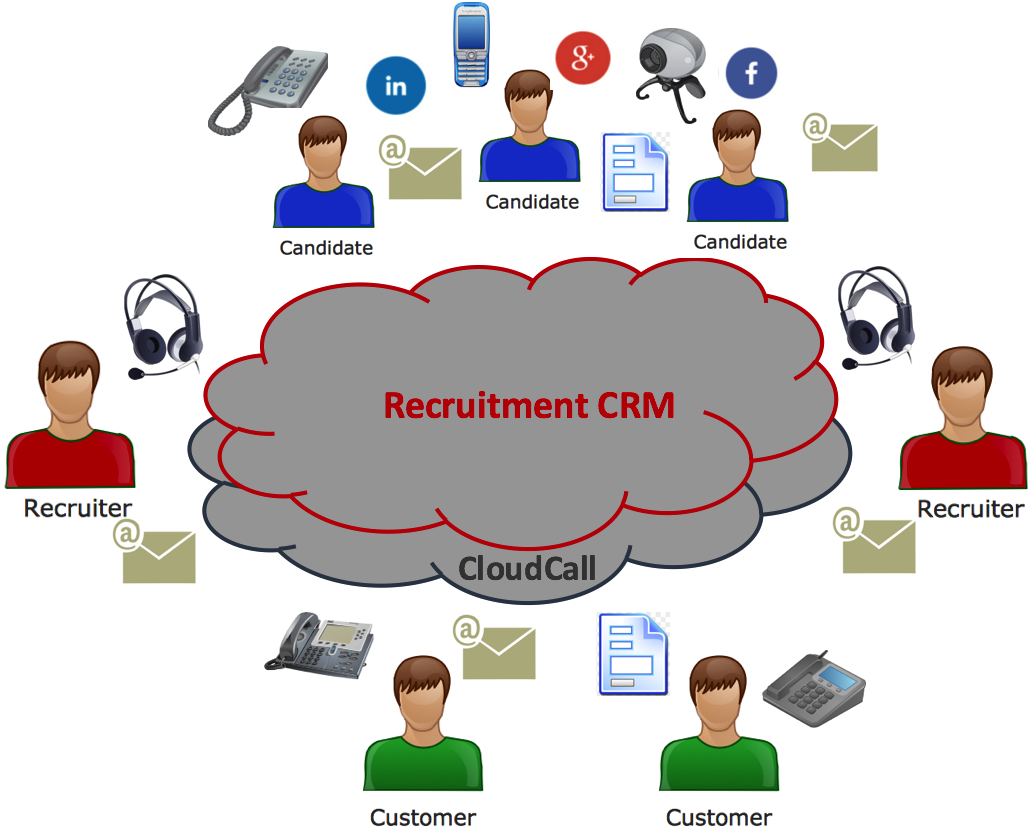
recruitment_touch_pointsHowever, many Recruitment businesses are experiencing disjointed customer and candidate journeys. This is primarily because the various touch points within the recruitment business operate within separate silos. For instance, it is still rare to see Recruitment and Staffing professionals working from a single system that gives a unified view of a Candidate (emails, phone conversations, CV and Social Data). This in turn means that conversations that happen between a candidate or customer and their recruiter rarely make it to the management team who can effect impactful actions and improvements based directly on this real-time information.

By the same principle, customer requirements also may not make it cleanly to the candidate or their recruiter allowing them to better determine if indeed they will make a good fit for the role in question. This emphasis on client and candidate openness will lead to better placement, less candidate churn and greater overall satisfaction which inevitably leads to increased repeat business.

Integrating real-time communications into the CRM creates the environment for agents to become far more productive. It streamlines training and simplifies onboarding and creates accountability across the organisation, this combination leads to better Customer and Candidate experience and greater employee satisfaction.

By unifying telephony into the Recruitment system it is possible to predict the destination of the outbound sales call and dynamically alter the sales person’s phone number to match closely the destination number location, greatly increasing the answer rate for that call. Powerful analytics gives businesses greater insight into conversation outcomes, best times to call and reduction in the need to make  lengthy ‘post call’ notes which impacts productivity.

The Business Impact of Unified Touch-points

Consistent and Unified Customer and Candidate Touch-points provide Recruitment Businesses with huge benefits including:

  • Increased Successful First Placements
    • Improved Customer Satisfaction
    • Repeat Business from existing Customers
    • Easier retention of Candidates (they know you place them accurately)
    • Less time spent re-placing roles which improves profit and reduces credit noting to customers.
  • Feedback reaches management faster
    • Giving Management Teams access to a Unified Customer and Candidate view including call recordings, outcomes and analytics will lead to faster Business improvements based on real unfiltered feedback directly inside your CRM records.
  • Knowledge sharing will improve across the organisation
    • Recruiters who have Business Development Teams and separate account management teams can suffer from information lag or proxy (2nd or 3rd hand information) to or from the candidate or customer. Removing the barriers to information sharing across voice and data will make the business more efficient for all concerned.
  • Voice Unification allows for a data driven Sales Processes
    • Calling contacts from inside the CRM ensures data consistency and quicker more accurate calling
    • Matching outbound calling numbers to the recipient destination increases pickup rates.
    • Integrating the call recordings of sales calls back into the CRM contact record ensures accountability and consistency
    • Real-time analytics of sales communications gives agents and management insight into the best calling times and conversation outcome.
    • Customer and candidate web enquiries no longer require manual processing in order to generate sales calls. The system automatically places the sales call and connects to the correct team or recruiter.

Implementing integrated communications into your Recruitment CRM system using a suitable CloudCall system is now straightforward and highly cost effective facilitating a clear return on investment.

Integrating your customer and candidate touch points leads to a better recruitment process and improved profit and retention.

The Rise of WebRTC and what it means to Businesses.

WebRTC is going to FUNDAMENTALLY change the way businesses interact with their Customers.

Within the next couple of years,  many Customer self service portals will have WebRTC (web real-time communications) capability which will connect your customer using audio, video or chat directly to your sales or service people without the need for a telephone at either end, using nothing more than their favourite  web browser.webrtc-logo-vert-retro-255x305

The technology is already here, the mainstream adoption is not, that is where the couple of years comes in. Welcome to the world of WebRTC.

WebRTC v1.0 is a standard based on the World Wide Web Consortium (W3C) which itself was based on original work developed at Ericsson Labs and later on by the WebRTC open source project published by Google in 2011.  WebRTC v1.1 (also known as ORTC – Object Real-time Communications) is currently in development and is actually part implemented in some web browsers already.

Essentially WebRTC gives the web browsers and developers a standard way of implementing and integrating real-time communications capabilities which have the ability to deliver four main capabilities which are 1. Voice Communication 2. Video Conferencing 3. Realtime chat 4. Information sharing (ie: desktop and file sharing). These capabilities are already pre-baked into the latest Web Browsers and platforms:

For PCs and Macs: Google Chrome, Microsoft Edge, Mozilla Firefox and Opera have support in their latest versions. Android Smartphones and tablets have  Google Chrome, Mozilla Firefox and Opera Mobile support.  Apple Smart Phone and Tablets (ie: latest iPhone and iPADs) have support in their  built in Web Browser. (Notable exceptions that do not have support are Internet Explorer and Apple Safari.)

Given the fact that there is already broad fixed and mobile platform support for WebRTC  the major barriers to adoption have been removed. In the next few years we expect to see this technology really come of age and proliferate throughout the business world.

WebRTC-Diag2

I know there will be some questions, so I have attempted to answer a few of the common ones below, but first the obligatory diagram showing how it can work.

What advantages does WebRTC give your business?

Firstly WebRTC gives you to ability to communicate more effectively with your Customers and Staff. The technology is programmable using HTML5 and Javascript – within the capability of most good Web Developers. The ability to integrate WebRTC functions into your business workflows, integrating to your existing Website,  Customer Portal and CRM means you do not have to swap out large chunks of your software or infrastructure to gain this capability.

Two example Use Cases (there are many more)

A Service Team wants to create more efficiencies with Customer Interactions. Using WebRTC they can create a WebRTC enabled web page in their Support Portal so customers can interact directly with the support team directly, maybe after creating a support ticket. The Support agents can also use WebRTC software and can receive a call/chat/video and desktop share from the customer without having to use a traditional or VoIP phone or any telecoms infrastructure at all. The communication is delivered from the Customer Webpage to the Support Agent via the company’s WebRTC service. Both the Customer and the Agent  have a camera, audio and microphone provided in their PC/Mac/iPAD/iPhone/Android which WebRTC uses and controls throughout the communications session.

A Recruitment Company wants to create a better way to interact with their Candidates and Customers throughout the interview process. The recruitment company contacts a WebRTC Service Provider who integrates a WebRTC solution into their interview process. This integration videos the candidate whilst they are answering a series of interview questions driven from the CRM and uploads the video as part of the candidate’s CV package which can be given to prospective employees. The candidate can use their PC/Mac/Laptop/iPAD/Android device to log on to the recruiters interview portal and run through the interview questions.

How secure is WebRTC?

WebRTC offers good security for calls. Signalling (instructions that tell WebRTC clients what to do next) is delivered over secure websockets (similar to https).  The media (the actual audio/video/messages/information) is transferred using SRTP (secure real-time protocol) again is also encrypted.  There are some minor security concerns to do with reading users IP addresses and of course there are the ones we haven’t discovered yet. The best advice I can give you is to consult a WebRTC/Integrated Communications specialist on such matters prior to implementing WebRTC inside your network.

What is the Call Quality like?

This is where we have to get a bit technical. The audio is encoded and decoded (the codec) using one of two methods or codecs as they are known – either G.711 or Opus. (Think Wav file or MP3 file.)

Both codecs offer good quality calls but Opus is more flexible because it can adapt to low bandwidth environments. Opus is actually based partly on the “Silk” algorithm which is used by Skype and can provide near HD quality using up to 80 kilobits per second (ISDN is 64 kilobits per second) all the way down to 6kb/s for bandwidth constrained environments like mobile – although don’t expect High Definition calls at that level!

The reality is that for any enterprise grade voice quality, you need to ensure that your own business local area network and wide area network (your internet connectivity) is capable of supporting voice calls over IP. That means no dodgy/cheap home-grade ethernet switches in your network and a properly setup router with Quality of service settings configured correctly. Best advice here is: Buy cheap, buy twice.

Peer to Peer or Client-Server?

Peer to Peer (web browser to web browser) communication is certainly possible using WebRTC. However the compelling Business case is where WebRTC clients (your customers and staff using WebRTC enabled applications) are connected through a WebRTC Gateway which will mediate the calls and even connect them to the PSTN (outside world) through a suitable SIP service. There are other advantages to routing the RTP through a central source, for example allowing calls and video to be recorded. Therefore my advice to you would be to seek advice from a suitably knowledgeable communications company as part of your planning.

WebRTC sounds interesting, where do I go from here?

My advice would be to speak to a few companies who are providing or planning to provide WebRTC services and also visit a good conference on WebRTC. A good one would be the European VoIP Summit in London in March 2016. I am on one of the Q+A sessions talking about WebRTC. More information is available by clicking here.

As a follow up, I am planning to write a couple of follow-up articles talking specifically about a few WebRTC applications which our company – SYNETY – will be launching later in 2016 so I hope you enjoyed the article and found it useful.

CloudCall API – the new way to build Comms Apps

During the last year, I have been working on a start-up called SYNETY which has developed a telecoms web service called the CloudCall API.

Building customised IVR, Outbound voice applications or Hosted PBX services  is currently an expensive proposition. Traditionally, you needed to purchase an IVR platform (software and hardware) then install either on-premise or host in a carrier’s data-centre, plug in E1 trunks and then build and test your application. As you grew, you would be constrained by the trunk capacity of your IVR equipment and as time went on, your application and IVR equipment would become out of date. Any idea how bad text to speech (TTS) or Voice recognition technology was just 3 years ago ?

CloudCall_Platform2011

Now there is a new way to build, test, deploy and scale your IVR or outbound communications applications – the SYNETY CloudCall API.

More information is available at www.cloudcall.com

SYNETY will be officially openening its doors for business on January 3rd.

SYNETY, Convergence and Unified Communications for SMEs.

Working in both Telecoms and Internet businesses for the last 16 years has given me a useful insight into convergence and the emergence of Unified Communications. 
cloud-scene.png

For me it all started in 1998 whilst I was 3 years into running my first ISP.  The initial emergence of Voice over IP technology was definitely too early. Then there was instant messaging and following closely was early software video conferencing, all bleeding edge technology, mostly unreliable but an indication of things to come.

As convergence of telecommunications and IT continued to progress through the noughties we started to see and hear the ramifications of this, from acquisitions of businesses to share value being slashed off public companies deemed to be on the back foot of these changes.

I know many telecoms reseller businesses that have been told they dead or dying if they do not embrace Unified Communications (posh name for converged communications) with this Software Company or that.

Indeed I’m guilty of this myself having been wrapped up so tightly inside an Eco-system that every fiber of me believed that UC was the life raft to every business in a recession and was truly bewildered by any business rejecting it.

It is true that some Unified Communications platforms like Microsoft Lync can help improve communications and bolster collaboration in certain multi-site businesses; the benefit really depends on the type, size and business culture.

Even though it may seem so, I’m not trying poo-poo Unified Communications or Microsoft Lync. I still believe it can be transformative for businesses in many circumstances but in my previous role I was focused solely on medium and large businesses but not any-more.  Now I’m back to my grass roots – focusing on startups and SMEs.

During the planning and preparation stages of our new business I’ve spent time talking to various small and medium sized businesses – from start-ups to 50 person businesses. I needed to find out exactly what SMEs really need from their communications in order to ratify our business strategy and generally get closer to the types of customer we will be supplying services.

I was surprised to find that many smaller businesses I interviewed have neither the technical capability nor the need to take full advantage of many of the features that this emerging technology offers. They don’t need to see people’s presence – they can just look over their desk. They don’t need desktop sharing – they can pull a chair up at someone else’s desk, and even when a couple enquired about whether their iPhone’s or Android would work with Lync the conversations soon turned to other technology.

Microsoft believes the phone is dead – and maybe it will be one day but not for now, not according to the businesses I spoke to.

I was also surprised to find that many of the business simply didn’t want big changes to their working practices or communications technology – many of them felt that it wasn’t the time to try radical new ways of working.

Instead, businesses want to improve and hone their working practices, in other words make small incremental changes with a low risk strategy, the theory being that a larger number of small incremental changes adds up to bigger changes down the line. In summary, the conversations always turned to improving not replacing.

Also given these un-certain times, the SMEs I spoke to wanted definite and measurable return on their investment on any new communications technology or systems and the return on investment needed to be in the months – not years.

They wanted low or no setup costs – definitely no CAPEX, a get out clause if it all goes wrong,  and the solution needs to be very easy to use and manage. Unsurprisingly I did find they were far more acceptable of outsourcing to the cloud but wanted to have good assurances around service quality and up-time.

In numerous occasions I found that businesses wanted to keep their existing software and telecoms in the most part or have the ability to improve their communications abilities and scale out existing systems using the cloud.

After planning SYNETY for nearly a year, I feel as though the business has now developed products and services that SMEs will want in order for them to incrementally improve their business performance.

In the following blogs, I will discuss the types of business issues our technology solves and provide in-site into the ongoing technology development.

Its early days, but following our launch this October,  I’m confident that  SYNETY can help many businesses achieve an improved bottom line.

My Top 12 Business Technology Bets for 2011

As we enter 2011 with optimism and trepidation in equal measure, it is clear that the number one objective for many small and medium sized businesses will simply be survival.

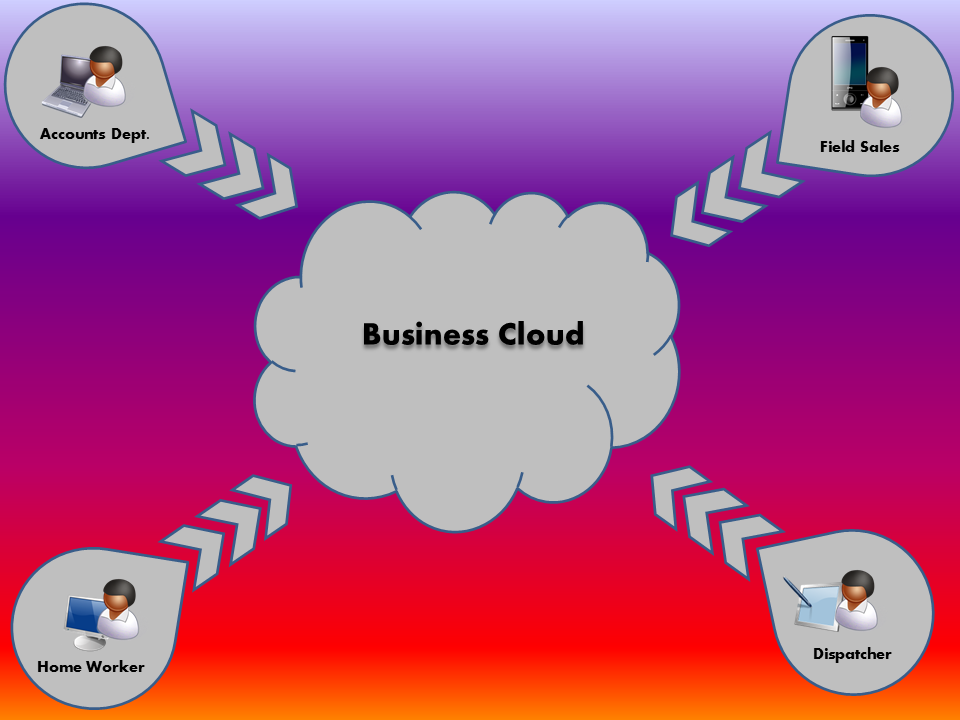
2011 will also undoubtedly be the year of the Cloud. The cost reduction that Cloud Software Technology can bring to businesses will mean that it will become main-stream in many counties and in many business sectors.

However, for businesses deploying Cloud, the story doesn’t stop there. For Cloud software technology to become breakthrough in terms of business productivity gains and cost reduction we also need new types of end user devices that are optimised to work with the cloud.

Business and The Cloud

Therefore my top 12 business technologies for 2011 will be focused on not only Cloud Software Technology but also the hardware devices that connect users to it.

Cloud Software Technology Bets

Communication Technology:

1) Microsoft Lync – The new Unified Communication Service from Microsoft will enable Businesses to communicate more effectively by introducing voice, video and virtual meetings using software powered from the cloud.

2) Hosted IP PBX & SIP Trunking – Various service providers are now selling phone systems as a service through the Cloud; this gives companies a more cost effective way to deploy telephone systems and makes connecting home workers a snap. Sip Trunking is a very low cost alternative to the traditional telephone line, SIP Trunking gives businesses a way to circumvent traditional Telco’s using their computer network instead. Cost savings can be up to 40% savings on line rental and call costs. SIP Trunking is usually deployed as a Cloud Service.

CRM (Customer Relationship Management) Technology:

3) Microsoft CRM 2011 Online – The latest release of Microsoft’s customer relationship software is designed to give businesses – small and large a complete system to optimise their sales, support and marketing functions saving money and improving the customer experience. This new version is available through various cloud services – including Microsoft’s own.

Collaboration, Analytics and Workflow Technology:

4) Microsoft SharePoint 2010 – This software allows businesses to share and collaborate using more than a web browser. Customers can create portals and use them to interact with customers, suppliers and employees. SharePoint also contains powerful workflow and reporting tools giving businesses more streamlined processes and giving them deeper insight into their business operations.

Hardware Virtualisation:

5) Microsoft’s Hyper V Cloud – This software technology allows businesses and service providers to easily “virtualise” their existing server hardware assets and either consolidate them to fewer servers or move them completely to the cloud. Virtualisation is really a core technology driving cloud computing and I believe that Hyper V Cloud will make it easier and more affordable for businesses to leverage their existing computer assets. Hyper V Cloud is currently the underdog to VMWare’s ESX product however I think Microsoft will make up substantial ground in 2011.

Business Hardware Technology Bets

Tablet PC Technology:

Apple’s iPAD has become a great success in both the consumer and business space and re-invigorated the Tablet format. My prediction is that 2011 will see a huge advancement for this format with many providers launching their products. My bet will be the tablet market as a two horse race between Apple and Microsoft.

6) Microsoft Tablet OS – The rumours are that Microsoft is readying a new tablet PC operating system. I suspect this to be true and would hedge a bet that it will be based on the recently launched Windows Phone operating system as it is more uncluttered than the PC based Windows for touch screen usage.

7) Apple iPAD 2 – building on the success of the first iPAD, Apple will surely launch the second version of their tablet and I expect this to include video conferencing as standard – a boon for business.

8 ) Android Tablet – numerous Tablet devices powered by Android are expected to launch in early 2011 including the Cisco Cius, Vizio, Toshiba and rumours are that HTC will be launching a unit called Scribe this year.

Smartphone Technology:

Smartphone use will continue to increase in business and I suspect their “dumb” phone equivalents will slide into oblivion within the UK business space by the end of 2011 or early 2012. The current UK market for “dumb” phones exists because of their low price and manufacturers like Nokia are bringing up the rear with ultra-low cost Smartphones (~£100) so there is really no reason to give an employee a dumb phone anymore.

9) Apple iPhone – The iPhone will continue to make progress in the Business space, driven by the application availability and the new multi-tasking capability.

Google’s Android – The Android platform will continue to go from strength to strength in the consumer space and 2011 will see the platform make substantial ground within the business space.

11) RIM’s BlackBerry – despite the talk of RIM suffering from the influx of devices from Google and Apple, the BlackBerry has gone from strength to strength in 2010 in the business space. Providing RIM can keep the innovations coming through, then I believe they will continue to prosper in the business smartphone space.

12) Windows Phone – Microsoft released its new phone operating system in 2010 and despite the naysayers, it was really quite good for version 1, if not the finished article. I expect the update to be released in the first half of 2011 which will include back-grounding of applications, interface improvements (including cut and paste) and some new applications such as a mobile Lync client (see Microsoft Lync above).  The remaining Achilles heal will be the available Windows Phone applications – currently a shadow of the AppStore, however Microsoft has huge resources at its disposal to rectify this situation so I expect this platform to prosper in the medium and long term.

My Top 5 Technology Products for 2010

2010 was an interesting year for IT and Telecoms technology. The realisation and general acceptance that Cloud as a Technology was here to stay has created some interesting propsitions in 2010 and this will follow through to 2011.

It’s about client (laptop, tablet, smartphone) connecting to the cloud software service. So with this in mind, I have compiled my top 5 technology products for 2010.

Apple’s iPAD must be on this list as it has single handily revived the Tablet form factor. The amazing thing is that it was primarily not as a corporate device however
businesses have been quick in embracing this consumer device, showing the consumerisation of IT at play here. The war of the Tablet’s is yet to play out, but 2011 will be the year to decide the winners and losers. Still with Apple, the launch of the utterly gorgeous MacBook Air shows just how far ahead Apple are in terms of hardware design.

Microsoft’s Phone 7 should be worthy of a mention, it’s a great phone and even though it has come in late to the party and has a few niggles (backgrounding), it should compete successfully with RIM, Apple and Android in both consumer and the business space providing Microsoft improves the quality and quantity of apps available in the Zune Market Place.

While on the Microsoft theme, the launch of Microsoft Lync 2010 Server should see Unified Communications come to the main stream and I’d even go further and say that this technology will be instrumental in re-defining business communications in the coming years plus further increasing the convergence in the IT and Telecoms sectors (Lync is also a PBX).

Microsoft’s Virtualisation technology Hyper V is now catching up with its competition – VMware – and their automated virtualisation platform called Dynamic Data Centre shows just how serious Microsoft are to win in this space giving service providers a fully automated and self-healing cloud platform.  We will see a number of Cloud providers launching DDC services in 2011 including Outsourcery.

How Microsofts Hyper V and Next Generation Hosted Unified Communications Platform will drive the Cloud model through the Telecoms Industry.

The economic environment and the improving quality and reduction of cost of broadband connectivity is tipping hosted iPBX products from early adoption in to the mainstream within the UK; there is still a way to go but all indicators point to this movement.

Microsoft Lync Server


Driven by the demand of small and medium sized businesses to have a flexible and mobilised workforce, companies are seeking out new technologies to help bolster their bottom line. Technologies such as Hosted iPBX and Unified Communications.

Its not just the SMB; the (cash strapped) public sector is also showing a keen interest in deploying their next generation telecoms and unified communications in the cloud in order to further reduce their operational costs.

While this shift is taking place, the Lync Server (Microsoft’s next generation communication Server) – single tenant version – is readying for launch and in less than a year later a multi-tenant version will be released.

Just A few years ago most single tenant server software would be deployed at a customers premise. However due to the maturing of virtualisation technology from Microsoft and others the deployment options are now somewhat different.

It is expected that many single tenant dedicated deployments will be placed in the cloud under the control of Dynamic Data Centre and other competing technologies.

Lync Server (Microsoft’s Unified Communication Server) will essentially replace the function of the on-premise PABX and even many functions of the advanced hosted iPBX systems currently on the market.

So if it will be possible to deploy a dedicated Customer Unified Communications System that replaces a company PABX and adds many advanced capabilities using very low cost hosted software low cost handsets and soft-phones – what will this do to the Telecoms Industry ?

The jury is still out, but one thing is for sure, change is coming!