

Ai capabilities in 2024 for small and medium sized Organisations to drive Employee Performance, Retention and Development

    This content is for People Leaders, Operational Leaders, CEOs, Team and Line Managers who want to create or implement a simple coordinated strategy leveraging the use of Ai in order to improve Employee Performance, Retention and Development within their workforce.

    Of course, there are many Ai tools in use across SMB and Mid-Market organisations, but for many their use is currently ad-hoc or uncoordinated. Our research has shown that in those smaller or mid-market organisations, HR and People teams are strapped for time with budgets squeezed so the usage of Ai powered tools is usually instigated by the individual or occasionally at team level.  Sales, marketing, and service teams usually do have the benefit of early integration of Ai into their respective core software tools however Ai integration into HR Tech smaller than the Enterprise level has so far been slower.

    The good news is that in organisations delivering or wanting to deliver frameworks or templates for Performance Management and/or Employee Development, there is now the availability and opportunity to incorporate Ai to help drive employee productivity in 2024 – not just for HR personnel but also for department leaders and line managers.

    Helping HR teams improve efficiency is great, but in an organisation of a say 500 people, HR people represent maybe 5 people (~1%) however line managers (any people with other people reporting into them), can be upwards of 20% of the workforce. Helping increase productivity in both groups will add material benefits of the overall organisational performance.

    In this article we examine a possible strategy for implementing AI for people ops within your organisation. We give workflow examples and use cases for using the different types of Ai and also we discuss potential issues with Ai bias and data regionalisation.

    If the mantra of 2024 is “Do more with Less”, then a co-ordinated Ai approach can help us achieve more with less this year.

    So, let’s dig into the detail by highlighting capability specifics for practical Ai Powered processes which can be implemented this year.

    Rather than concentrating on the ah-hoc tools which employees can utilise to improve their personal productivity (example: blog/email creation software) here we are focusing on technology which can be implemented directly in-line with existing business workflows to make them more efficient and less people dependant.

    So here at StaffCircle our strategy is based in interfacing with three types of Ai – Generative Ai, Predictive Ai, Conversational Ai in orderto deliver practical day-to-day value in 2024 for customers.
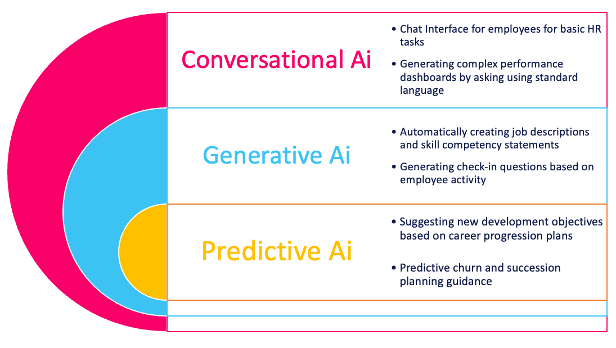
    Conversational Ai

    Creating a conversational interface using natural language for your workforce provides a number to advantages including simplifying the usage of sophisticated tools used by non-technical users.

    • By providing a conversational interface (chat window) inside or outside of your HR Tech tools will enable the translation of a natural language request into either direct output or by opening the relevant screens or applications.
    • On-demand generation of analytical reports or dashboards by using natural langue queries.
    • Later enabling speech to text interfaces for the above would negate the need to operate the software using conventional keyboard and mouse or touchscreen.

    Generative Ai

    In relation to HR Tech, generative Ai refers to the automated creation of text and images utilising the people data held within the people system(s).

    Some examples:

    • On-demand generation of People Reports based on available platform data.
    • Auto-generating questions for a review or check-in based on its description and/or audience.
    • Auto generation of your competency framework based on role name and description.
    • Summarisation of performance based on last month/quarter/bi-annual data.
    • Summarisation of personal development goals for this year based on career path, next role and competency requirements.
    • Auto-generation of key results when creating OKRs or of relevant metrics when creating a Smart Objective.
    • Summarising areas of development based in performance, engagement, and development feedback as well as gaps in skills.
    • Summarising feedback from surveys or from 360 reviews or appraisals.
    • Suggesting Awards or feedback for individuals based on employee performance or developmental achievements.

    Predictive Ai

    In relation to HR Tech, Predictive Ai refers to the analysis of people data by Ai in order to predict or anticipate future events or people within your company.

    Some examples:

    • Utilising performance, engagement and development data to predict organisational succession candidates and hyper-personalised career development plans.
    • Provide areas of learning based on future roles of each employee.
    • Predict and visualise employees career paths based on personal development statements.
    • Generate Dashboards and reports predicting potential Employee attrition.
    • Hyper customised employee benefits based on HRIS employee of record data.

    Using Predictive Ai to analyse and understand multiple Employee Signals

    Providing you capture the data in the first place, there are multiple signals which happen in an employee’s timeline that when combined with others can show a pre-warning of potential attrition long before its uncovered by a survey or one2one or worse an exit interview.

    Getting access to all these employee signals can be difficult because many of them exist in disparate systems – but when combined and accessible by the correct Ai tooling it can provide Organisations with game changing analytics.

    Challenges with data regionalisation when Ai is implemented

    Depending on the cloud platform utilised and the location of the Ai models and data stores, careful consideration for data location needs to be applied when adopting Ai capabilities. For example, if you are a UK organisation with strict data regionalisation rules and cannot have employee data or subset of that data move in and out of the UK region then you have to consider carefully the cloud services abilities to keep the data within the county. Some platforms currently do not enable strict regionalisation of data when using Ai capabilities so if your HR tech is built on such a platform then this needs careful consideration. NB: StaffCircle platform is built natively on Microsoft Azure which does support strict regionalisation

    Challenges with Predictive Ai

    Machine Learning Models need to ingest large amounts of data so a shortage of relevant data for the model can be an issue. especially when it comes to predicting future outcomes based on analysing patterns in that existing data. In HR terms, this can affect predictions for succession planning, attrition, and of course employee performance. Concerns exist about potential bias of results so outputs should always be used as guides rather than absolute truths. Nevertheless, this type of prediction data can be incredibly valuable for organisations looking for deep insight into behaviours and trends.

    Challenges with Generative Ai

    Generative Ai can create good if not great content – sometimes a bit too samey.

    The issue revolves around the fact that two pieces of content created from similar inputs will result in relatively similar outputs especially if the input data is not highly detailed and scenario specific. However, for large data creation tasks where unique content isn’t such a huge issue (example when creating role descriptions or 360 review or interview questions) then this can be a huge time save.

    Getting Ai in your workflows – what to look for in HR Tech

    Ensure your HR tech has APIs which Ai Tools can use to ‘see’ your data. Even if your existing HR tech isn’t yet Ai enabled, having access to a useful set of reporting APIs will enable you to leverage 3rd party Ai systems to interrogate your people data.
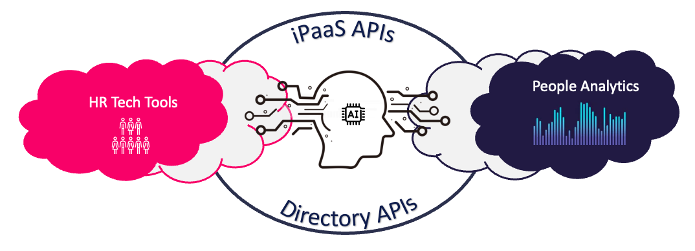
    Choose HR Tech platforms that collect meaningful data about your employees, not just the holiday bookings but performance and development data as well as content engagement stats. The wider the data relevancy the better the predictions will be providing the models are configured correctly.

    Ai Skills shortage, Deployment lag and the Opportunity

    Of course, Ai news flood is all around us with new ML and Deep Learning features with the latest Ai software and hardware announcements hitting us almost every day. This plethora of information can be confusing and make it difficult to disseminate a strategy from it all despite the advantages this will bring to the organisation. And this problem is real, when you look at the deployment of Ai inside SMB and Mid-Market specifically in HR / employee workflows the uptake is slower apart from the individual take-up of Ai features which aren’t yet integrated in the existing workflows and mostly driven from curiosity and not wanting to miss out or fall behind of the Ai wave.

    We know that direct uptake of deep integrated technology inside larger organisations is driven by leadership teams and this includes Ai.  However, recent research from Workday found that HR leaders need to proactively upskill teams to build confidence in new technologies, with 32% believing employees don’t have the technical skills to work well with AI.

    Working off our own data for mid-market we are seeing large scale individual usage of Generative Ai for content creation across many roles. We are seeing large take up of Ai features through organisational usage of sales, marketing and service software.  

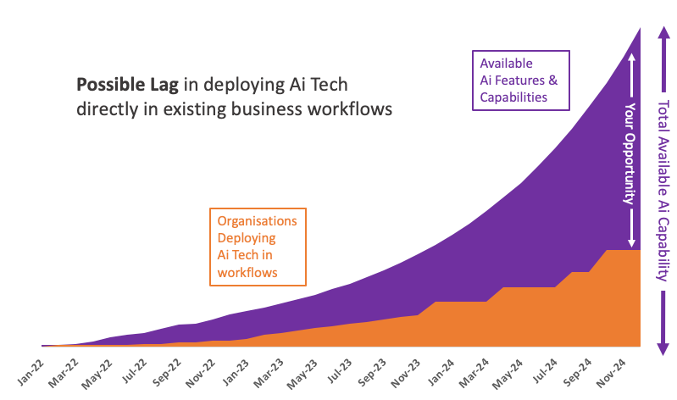
    But there is a lag between Ai capability availability and actual deployments inside existing or new organisational HR and people workflows.

    I believe there are a number of reasons for this, one is the actual understanding and/or training of current Ai capability in terms of HR and People Management as well as the ability to integrate the Ai Technology into the organisations existing HR Tech stack. Also given the amount of news and hype, there is certainly an element of not seeing the wood from the trees.

    The immediate Opportunity is based on you deploying Ai Tech into your people workflows where others haven’t.  When competing for talent or retraining and developing your existing talent – knowledge is everything and Ai helps bridge the gap between your data and knowledge or insight. Afterall you make decisions not based on data but on the insights rendered from your data and Ai can help improve your ability to render data in a more meaningful way.
    In summary, your Ai Strategy, if implemented effectively, can reduce manual work, make your people far more effective by reserving more of their time for high value tasks and help turn your plethora of people data into highly valuable organisational insights.

    Talk to your vendors about Ai strategy and ask for their insights to get a sense if they are or going to be leaders in this space.

    Of course, please talk to us if you would like to see the next generation of Ai tech for employee performance and development.
    Dynamics CRM 2011 Online Launches – Opportunity or Threat for Dynamics Hosting Partners?

    Microsoft launched their CRM 2011 Online offering in the 18th of January 2011 giving customers worldwide the ability to rent and host their CRM Dynamics applications directly with Microsoft.

    Some naysayers and sabre rattlers talk of Armageddon for the CRM Hosting Community and in doing so display their complete lack of understanding of the complex and individual requirements of customers, the capabilities of the hosting providers, their routes to market, and the most importantly the Dynamics business space in general.

    To a misinformed few, the belief is that every time a major Microsoft Online launch happens – across its hosting products, any hosting company providing a similar product will be blasted into oblivion.

    As CTO of Outsourcery (one of the world’s leading Hosted CRM Providers) and the architect of its product strategy, I think it’s a good time to speak from a service provider perspective; specifically on the launch of CRM Online and discuss the opportunity for service providers like us.

    CRM stands for Customer Relationship Management and Customer Relationships encompasses the entire lifecycle of a customer including all interactions – real-time and non-real-time. As business people, we quote, support, sell, market to our customers; but we also talk to them on the phone, meet them, video conference, instant message, and share information with them.

    My belief is that CRM technology in general is in a very early stage of development. That withstanding, Microsoft CRM Dynamics is the best CRM technology currently available, helping businesses to streamline their operations and gain greater control of their businesses. However in order to extract the maximum value on a CRM system, we need to cover as many customer interactions in the CRM platform as possible. In order to do this we must integrate with other systems and products; some of them Microsoft, some of them not.

    Asking a single Cloud Service provider to integrate a huge variety of products into their CRM offering is an extremely complex task and one which neither Microsoft nor other independent CRM Hosting Providers will deliver tomorrow (or in the next couple of years).

    In additional, Customers of scale wanting a CRM deployment in the cloud require heavy customisation and integration of the CRM deployment with other business line applications. Some customer’s require their data to stay within the UK or on a dedicated (not shared) SQL back-end. These types of deployments are more suitable for a DDC deployment and not a Partner multi-tenant or Online deployment.

    So is there an opportunity for independent CRM Hosters? Of course there is. Do they need to differentiate?  Of course they do,  what business doesn’t? However, the market opportunity for CRM is enormous as collectively, hosting and on-premise businesses have barely scratched the surface with deployments. What the CRM Online launch does achieve is to give more credence to the hosting or cloud model, be it Microsoft Online or Partner Hosted, something which it has previously lacked.

    The real opportunity for CRM hosters is the ability to offer “the power of choice” – Same core CRM product but different deployment options depending on customer circumstance. Soon even a hybrid model will be possible where some users are on MS Online and some on partner hosted – all within the same Organisation.

    This is why Outsourcery has chosen an infrastructure agnostic model – same core technology but different deployment options giving customers the power of choice. Outsourcery believes that Cloud is a more efficient distribution model when used at scale – let the internet deliver the software rather than a courier – it’s cheaper for everyone that way.

    So what is the real threat to Microsoft CRM hosters’? I certainly don’t think its Microsoft. To me it’s clear: Salesforce.com – just a pity that point wasn’t picked up by the sabre rattlers!


    My Top 12 Business Technology Bets for 2011

    As we enter 2011 with optimism and trepidation in equal measure, it is clear that the number one objective for many small and medium sized businesses will simply be survival.

    2011 will also undoubtedly be the year of the Cloud. The cost reduction that Cloud Software Technology can bring to businesses will mean that it will become main-stream in many counties and in many business sectors.

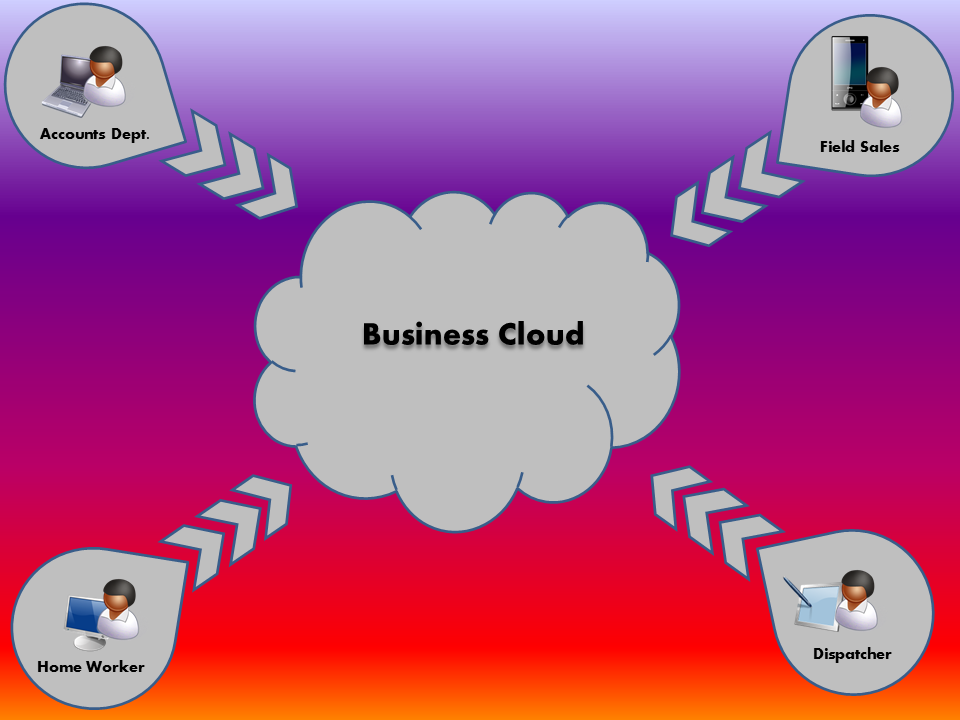
    However, for businesses deploying Cloud, the story doesn’t stop there. For Cloud software technology to become breakthrough in terms of business productivity gains and cost reduction we also need new types of end user devices that are optimised to work with the cloud.

    Business and The Cloud

    Therefore my top 12 business technologies for 2011 will be focused on not only Cloud Software Technology but also the hardware devices that connect users to it.

    Cloud Software Technology Bets

    Communication Technology:

    1) Microsoft Lync – The new Unified Communication Service from Microsoft will enable Businesses to communicate more effectively by introducing voice, video and virtual meetings using software powered from the cloud.

    2) Hosted IP PBX & SIP Trunking – Various service providers are now selling phone systems as a service through the Cloud; this gives companies a more cost effective way to deploy telephone systems and makes connecting home workers a snap. Sip Trunking is a very low cost alternative to the traditional telephone line, SIP Trunking gives businesses a way to circumvent traditional Telco’s using their computer network instead. Cost savings can be up to 40% savings on line rental and call costs. SIP Trunking is usually deployed as a Cloud Service.

    CRM (Customer Relationship Management) Technology:

    3) Microsoft CRM 2011 Online – The latest release of Microsoft’s customer relationship software is designed to give businesses – small and large a complete system to optimise their sales, support and marketing functions saving money and improving the customer experience. This new version is available through various cloud services – including Microsoft’s own.

    Collaboration, Analytics and Workflow Technology:

    4) Microsoft SharePoint 2010 – This software allows businesses to share and collaborate using more than a web browser. Customers can create portals and use them to interact with customers, suppliers and employees. SharePoint also contains powerful workflow and reporting tools giving businesses more streamlined processes and giving them deeper insight into their business operations.

    Hardware Virtualisation:

    5) Microsoft’s Hyper V Cloud – This software technology allows businesses and service providers to easily “virtualise” their existing server hardware assets and either consolidate them to fewer servers or move them completely to the cloud. Virtualisation is really a core technology driving cloud computing and I believe that Hyper V Cloud will make it easier and more affordable for businesses to leverage their existing computer assets. Hyper V Cloud is currently the underdog to VMWare’s ESX product however I think Microsoft will make up substantial ground in 2011.

    Business Hardware Technology Bets

    Tablet PC Technology:

    Apple’s iPAD has become a great success in both the consumer and business space and re-invigorated the Tablet format. My prediction is that 2011 will see a huge advancement for this format with many providers launching their products. My bet will be the tablet market as a two horse race between Apple and Microsoft.

    6) Microsoft Tablet OS – The rumours are that Microsoft is readying a new tablet PC operating system. I suspect this to be true and would hedge a bet that it will be based on the recently launched Windows Phone operating system as it is more uncluttered than the PC based Windows for touch screen usage.

    7) Apple iPAD 2 – building on the success of the first iPAD, Apple will surely launch the second version of their tablet and I expect this to include video conferencing as standard – a boon for business.

    8 ) Android Tablet – numerous Tablet devices powered by Android are expected to launch in early 2011 including the Cisco Cius, Vizio, Toshiba and rumours are that HTC will be launching a unit called Scribe this year.

    Smartphone Technology:

    Smartphone use will continue to increase in business and I suspect their “dumb” phone equivalents will slide into oblivion within the UK business space by the end of 2011 or early 2012. The current UK market for “dumb” phones exists because of their low price and manufacturers like Nokia are bringing up the rear with ultra-low cost Smartphones (~£100) so there is really no reason to give an employee a dumb phone anymore.

    9) Apple iPhone – The iPhone will continue to make progress in the Business space, driven by the application availability and the new multi-tasking capability.

    Google’s Android – The Android platform will continue to go from strength to strength in the consumer space and 2011 will see the platform make substantial ground within the business space.

    11) RIM’s BlackBerry – despite the talk of RIM suffering from the influx of devices from Google and Apple, the BlackBerry has gone from strength to strength in 2010 in the business space. Providing RIM can keep the innovations coming through, then I believe they will continue to prosper in the business smartphone space.

    12) Windows Phone – Microsoft released its new phone operating system in 2010 and despite the naysayers, it was really quite good for version 1, if not the finished article. I expect the update to be released in the first half of 2011 which will include back-grounding of applications, interface improvements (including cut and paste) and some new applications such as a mobile Lync client (see Microsoft Lync above).  The remaining Achilles heal will be the available Windows Phone applications – currently a shadow of the AppStore, however Microsoft has huge resources at its disposal to rectify this situation so I expect this platform to prosper in the medium and long term.

    Cloud Safety – Are Cloud Services secure Enough for Business Use?

    SMB’s who are thinking about embracing the Cloud as their cores IT strategy have a number of concerns.  The main concerns centre around service reliability, accessibility and security of data stored in the Cloud and I will cover the security element in this article.

    Firstly let’s agree that there are numerous types of Cloud Service and I will be talking about two types:

    SaaS (Software as a Service) – a multi-tenant Cloud service and vDedicated Cloud Servers – one or more virtualised dedicated server operating and managed in the cloud.

    SaaS provides business end users with a low cost software service provided on an OPEX or rental model. With SaaS the computer hardware (physical or virtualised) is spread across all of the users that use the SaaS service.  Each user belongs to a specific Organisation and cannot access or see other users from other Organisations even though they all reside on the same platform. When services require data access and storage they utilise SQL databases – such as Hosted CRM and each organisation has a separate database for their data. Because of this each organisation cannot access anyone else’s data even if it is stored on the same physical database server.

    vDedicated Cloud Servers are essentially virtual “guest” servers running on a physical “host” server. Each server is its own entity even though many virtual servers (guests) can share the same physical hardware. In other words they cannot access the other virtual servers running on the same host – unless specifically configured to do so.

    Real-time Unified Communications services such as the multi-tenant Microsoft OCS or Microsoft Lync provide separation by using “Chinese walls” which are made up of scripts and permission settings that separate users from users within another Organisation preventing cross-organisation contamination of Information.

    So if SaaS and vDedicated Cloud Servers are pretty secure, what about customer access security?  Most client access to cloud services are done by using secure web access call https which is usually protected by 128 or 256 bit encryption.

    HTTPS is the same security provided to you by the banks when you access your online banking information – so if it is secure enough to protect your private finances it must be secure enough for company data.  However, one area that the online banking is more secure that SMB Cloud Services is the authentication system mechanism used when you log in to their services and I believe this is an area that SMB Cloud Service Providers have some room for improvement.

    Users authenticating themselves onto many current SMB Cloud services are required to provide a username and password. Many good Cloud Providers require the users to enter stronger passwords – such as 6-8 minimum chars with at least one number and one capital letter which reduced the risk of password cracking. Also some Cloud Providers require users to change their passwords on a regular basis; however, sometime this can prove more insecure as users tend to write them down rather than memorising them.

    There are a large number of solutions to improve authentication security – RSA Smart Tags is one of them and there are many more – it is just a question of Cloud Providers implementing them – which they will do if they see a demand from customers.

    Finally, over the last 15 years of providing IT solutions to SMBs, I have come across many shamelessly insecure on-premise IT implementations that could have been easily hacked and data stolen. The reality is that SMBs do not have, or rarely can afford the type of expertise required in order to fully secure their IT assets.

    At least Cloud Service Providers will now share a large part of the responsibility of data security with the SMB and this is a good thing – because Cloud Service Providers are in a far better position (technically and procedurally) to provide businesses with secure access to their vital data.

    BT Infinity is launched and the Rural Broadband Divide widens once again.

    Old Bike or Rural Broadband Speed ?

    Old Bike and Rural Broadband Speed

    The country is waking up to the news that BT is finally rolling out their 50MB fibre-optic broadband product called BT Infinity and Virgin announce their 100MB service. The consumers and businesses located in major towns and cities should be jumping with joy at the prospect of super-fast broadband at their home or business whilst those that live in a rural area sigh once again at the prospect of the digital divide widening even further. Rural areas will be stuck on 2MB max download and the rest of the country  on 8MB and soon rising to 100MB.

    I’m speaking from experience as I live (and built several businesses)  within a rural area of Warwickshire, 10 miles from Leicester but within the BT exchange reach of a delightful but very small market town.

    The broadband here is woeful and indicative of other rural areas; the best connectivity available at 2MB download but most broadband delivers between 400 and 800kb download (my own ADSL runs at 600kb).

    I personally know of a number of businesses that moved from my rural area to Leicester simply because of the connectivity problems associated with a rural area – two of these businesses were my own and there are countless more across the country.

    Unfortunately this is an issue that won’t be solved without radical thinking as it’s a question of economics not technology.

    For the likes of BT or Virgin to roll-out fibre to small rural areas is prohibitively expensive and actually not viable in some areas as rural properties mostly have the BT lines going straight back to an exchange and not through a street side cabinet. Many of the actual copper wires are too long to support high speed broadband.

    The fact is that high speed broadband is becoming more and more vital for consumers and businesses and this doesn’t change whether you live and work in a rural area or city – it’s still critically important.

    Therefore the issue must be solved if we are to finally close the digital divide, stop people and businesses migrating needlessly to cities, and finally create equal and fair access to high speed broadband for all.

    There are options; the first was mentioned in one of my previousarticles that centred on a Broadband Grant System giving subsidies to businesses who order more expensive private circuits. Unfortunately there seems to be little appetite for the government to shell out money for this system given the current austerity measures being rolled-out.

    However, there is a second way to deliver fast broadband to rural areas without requiring government subsidies. This plan involves two parts;

    Firstly, BT launched a new product available under their LLU (local loop unbundling) program. This new product simply consists of a discounted bundle of 4 or 8 copper LLU lines – something that can be accomplished by them quite easily. Once these bundled lines are available for a lower cost, an LLU provider (or indeed BT themselves) could combine the bandwidth’s across these lines to present the end user a single broadband connection with 4 or 8 times the bandwidth of a single ADSL which would equate to approx. 10meg connection or on a very long distance a minimum of 4meg download which is significantly better than the 500kbs achieve today on long distance rural connections.

    Secondly, BT making available a discounted backhaul link for LLU providers. This fibre link would allow the LLU provider to connect the local rural exchange back to their network (usually in London) for a discounted rate.

    Together these two elements would enable every ISP to deliver rural high speed broadband services whilst making money in the process which would encourage ISPs to deliver without having to incur the costly expense of digging up roads and laying fibre.